

Dog grooming at home works best as gentle maintenance, not a test of how much you can do yourself. If you’re unsure which tools to use or worry that a bath, brush, or nail trim might make your dog nervous, even a simple routine can feel difficult to manage.
Keep basic care manageable by working at your dog’s pace and focusing on tasks they tolerate comfortably. This guide explains what you can maintain at home, how to make sessions more relaxed, and when matting or a complex haircut is better left to a professional. You’ll also find a practical way to build a routine without trying to do everything at once.
For care beyond home maintenance, mobile grooming brings professional attention to your doorstep in a fully equipped, cage-free van. Pawgo offers Full Groom and Bath & Tidy appointments, along with options such as nail trimming and teeth brushing. Read on to decide what to handle at home and when professional grooming may be a more comfortable fit.
Key Takeaways
- Build dog grooming at home around your dog’s coat and comfort rather than following one schedule for every breed.
- A quiet, well-lit space and a stable, non-slip surface can make basic care feel more settled.
- Use a gentle routine: settle your dog, inspect their coat, brush carefully, and pause if they seem uncomfortable.
- Know when a task is beyond routine upkeep. Severe matting and complex haircuts may be better handled by a professional.
- When home maintenance isn’t enough, mobile grooming brings professional care to your doorstep.
Dog grooming at home: what routine care can, and cannot, do
Dog grooming at home means routine coat and hygiene care you can manage safely with your dog. It does not replace every professional grooming service. Brushing, bathing when appropriate, and gentle attention to nails and teeth can help maintain comfort between professional visits. The right routine depends on your dog’s coat, temperament, and tolerance for handling. There’s no single checklist that suits every dog.
Home care takes place in familiar surroundings, and you can pause whenever your dog needs a break. Gentle, regular handling also gives you a chance to notice changes, such as a new tangle, unusual odor, or a patch of coat that looks different. The Dog grooming overview provides broader context on the purposes and common approaches to grooming.
Which grooming tasks are realistic to maintain at home?
Brushing is often a useful place to start. Choose a brush suited to your dog’s coat, use light strokes, and avoid pulling at knots. A brief session that ends calmly is more useful than pushing through an uncomfortable one. Bathe your dog when they are dirty or their coat needs washing, using a dog-formulated shampoo and following its directions.
Nail and teeth care can also be part of routine maintenance if your dog accepts the handling and you feel confident doing it. Introduce each task gradually. If your dog pulls away or becomes unsettled, stop rather than forcing them to continue. Home grooming supports basic care; you don’t have to complete every task in one sitting.
When is home grooming not the right approach?
Some situations call for different support. Severe matting can be difficult and uncomfortable to remove, while skin changes or signs of pain need professional attention. A groomer can help with grooming needs, but they don’t diagnose or treat medical conditions. For a skin concern, injury, or suspected pain, seek veterinary guidance.
Stop if your dog shows distress, struggles to get away, or handling starts to feel unsafe. Don’t cut close to the skin to remove a tight mat or continue through resistance. Give your dog space and choose a safer next step. A professional groom can be a better fit for complex coat work or tasks that are difficult to manage calmly at home.
When routine maintenance isn’t enough, Pawgo brings professional grooming to your doorstep in a fully equipped, cage-free mobile van. Full Groom and Bath & Tidy appointments provide options for care beyond what you’re comfortable handling at home.
Set up a comfortable, low-stress dog grooming space at home
A calm setup makes grooming easier to start and simpler to pause. Choose a quiet, well-lit area where your dog can stand or sit on a stable, non-slip surface. A familiar room may be less distracting than a busy part of the home. Keep the space comfortably warm, with enough room to move around your dog without pulling or twisting their body.
Gather everything before inviting your dog over. Reaching for supplies mid-session can interrupt the routine. Leaving a dog unattended on a table or other raised surface can also create a fall risk. For basic care, prepare:
- Brushing: A brush or comb suited to your dog’s coat.
- Bathing: Dog-formulated shampoo, if a bath is appropriate, and towels for drying.
- Clean-up: A small container for used supplies and a clear place to set clean items.
Keep the setup simple. Dog grooming at home is about comfortable routine care, not collecting a large selection of tools. The ASPCA Dog Grooming Tips also provide practical guidance on common grooming activities and preparation.
Choose tools that suit your dog’s coat
The right brush depends on coat length, texture, and condition. A tool that works well on a short, smooth coat may not suit a long or dense one. Choose a brush you can hold steadily and use without pressing hard. Start with light strokes in an area your dog accepts, then watch their body language as you continue.
If you meet a knot, don’t tug or force the brush through it. Pause and see whether it can be eased gently. Stop if your dog shows discomfort or the mat is difficult to reach or separate. Continuing can make grooming unpleasant and may hurt their skin.
Make the grooming area feel predictable
Let your dog explore the space before you start. Allow them to sniff the towel or brush, then begin with a brief, familiar touch instead of moving straight into a full session. Keep your movements steady and offer short pauses. Calm praise or a suitable treat can reward relaxed cooperation if your dog is comfortable taking it.
End the session before either of you feels rushed. Brush one area today and leave bathing or another task for a different time. If your dog becomes uneasy, stop and give them a chance to settle. For a professional option without salon travel, Pawgo provides mobile dog grooming at your doorstep.
Match at-home grooming to your dog’s coat and comfort level
Dogs don’t all need the same brushing approach. Coat length, texture, and condition affect which tools are useful and where tangles may form. Your dog’s comfort matters just as much: a task that’s simple for a relaxed dog may be too stressful for one who dislikes being touched or held in place.
Let your dog’s coat and comfort guide what you attempt at home, keeping each task gentle and manageable. Use this comparison as a starting point, not a fixed schedule. Check the coat as you handle it, then adjust based on what you see and how your dog responds.
| Coat type | At-home care to consider | Take extra care with |
|---|---|---|
| Short | Gentle brushing to remove loose hair and check the skin. | Using more pressure or longer sessions than needed. |
| Long | Careful, section-by-section brushing to find tangles. | Pulling through knots or skipping areas where hair rubs together. |
| Curly | Gentle, thorough brushing that helps prevent tangles from tightening. | Brushing quickly through dense curls or mats. |
| Double | Coat-appropriate brushing that attends to both the outer coat and areas where loose undercoat gathers. | Shaving as a shortcut or using a tool that catches and pulls. |
How does coat type change the home-care approach?
Short coats often need gentle attention rather than intensive styling. Longer and curly coats can tangle more readily, so slow brushing helps you notice resistance before it becomes a painful pull. Double coats need care suited to their layers. Don’t shave one simply to make home maintenance easier. If you’re unsure how to handle a difficult coat, a professional groomer can help.
What if your dog dislikes grooming or has difficult mats?
Watch for signals such as pulling away, freezing, turning to avoid the brush, or repeatedly trying to leave. Pause instead of restraining your dog to finish. A difficult mat is not a reason to tug harder or cut close to the skin. Professional grooming is a safer choice for complex coat work, while pain or skin concerns call for veterinary advice.
Your dog’s comfort can shape the task as much as coat type. If your dog is relaxed with brushing but uneasy about having their feet handled, stick to brushing for now. Build tolerance gradually with brief, calm handling, and stop if your dog becomes distressed. The goal is a routine your dog can accept, not completing every grooming task in one session.
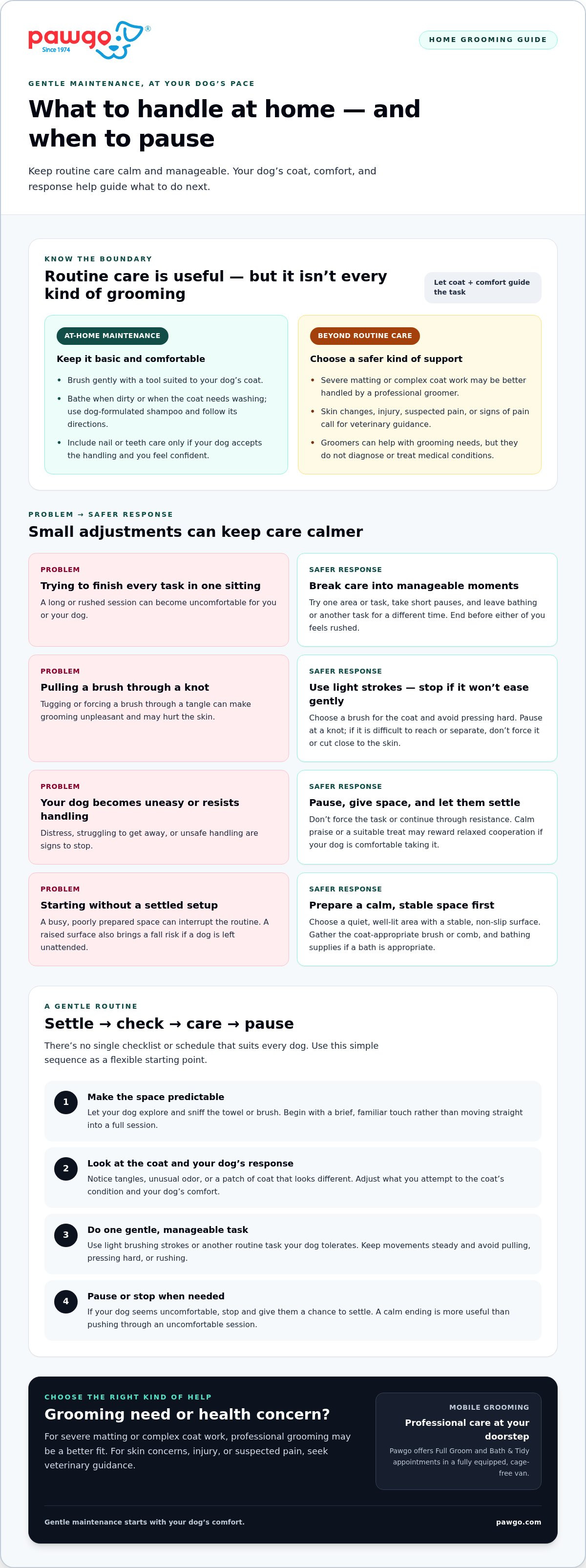
Follow a simple, gentle routine for dog grooming at home
A predictable order helps you focus on your dog’s comfort instead of rushing to finish every task. Before you begin, gather your supplies and choose only the care your dog needs that day. Brushing doesn’t have to turn into a bath, nail trim, and full-body inspection. A short, calm session is a worthwhile routine on its own.
What order should a basic grooming session follow?
Use this sequence as a flexible guide. Skip any step that isn’t appropriate for your dog’s coat or comfort:
- Settle your dog. Give them a moment to adjust to the space and your touch. Start when they seem comfortable rather than holding them in place.
- Inspect the coat and skin. Look for tangles, debris, redness, or areas your dog reacts to. Don’t brush over a sore-looking spot or try to diagnose a skin change.
- Brush gently. If brushing is suitable, use a coat-appropriate tool and light strokes. Stop at knots that resist rather than pulling through them.
- Bathe only if needed and suitable. Use comfortably lukewarm water and shampoo formulated for dogs. Keep water and shampoo away from the eyes, then rinse thoroughly so residue doesn’t remain in the coat.
- Dry and check comfort. Towel-dry gently without vigorous rubbing. Check that your dog is comfortable and the coat isn’t left damp in areas that are difficult to reach.
How can owners keep grooming safe and positive?
Let your dog’s response set the pace. Work on one area, pause, and offer a break if they shift away or seem unsettled. You can return to another task later. Dog grooming at home is about steady, comfortable maintenance, not completing a full checklist in one sitting.
Use a clear stop rule: stop if your dog shows distress, reacts as though something hurts, develops visible irritation during grooming, or can’t be handled safely. Don’t use restraint to push through a difficult task. Avoid scissors or clippers close to the skin unless you have the skill and control to use them safely. Severe mats and complex coat work are better handled by a professional groomer.
If you notice skin changes, pain, or another health concern, pause grooming and seek veterinary advice. Grooming can help maintain a coat, but it can’t diagnose or treat a medical issue.
For a professional grooming visit at your doorstep, explore Pawgo’s mobile grooming options, including Full Groom and Bath & Tidy.
When mobile dog grooming is a better fit than grooming at home
Home care can keep a coat comfortable between grooming visits, especially when your dog tolerates gentle brushing. Routine maintenance doesn’t need to become a struggle or replace every professional task. If a haircut is complex, mats are difficult to manage, or your dog becomes distressed during grooming, professional support may be a calmer choice.
Mobile grooming brings professional care to your doorstep without a trip to a salon. It’s a practical option when you want professional grooming close to home or when grooming tasks are difficult to manage at home. You can still handle simple care yourself and arrange professional grooming for work that feels beyond your experience.
Signs your dog may benefit from professional grooming
Consider professional help if brushing repeatedly catches on dense tangles, your dog’s coat needs shaping you’re not confident doing, or grooming sessions keep ending in discomfort. Forcing a difficult task can make future handling more stressful. A professional groomer can help with coat care, but signs of pain, irritated skin, or other health concerns should be discussed with a veterinarian.
- Difficult mats: Don’t tug, cut close to the skin, or keep working if a mat resists gentle handling.
- Complex coat work: A style requiring careful shaping may be better left to a professional.
- Repeated distress: If your dog keeps pulling away or can’t settle, stop and consider another approach.
How Pawgo brings grooming to your doorstep
Pawgo provides mobile grooming at customers’ doorsteps in fully equipped vans with a cage-free grooming environment. Appointment options include Full Groom and Bath & Tidy. Listed additional services include a scissor finish, nail trimming, teeth brushing, and medicated shampoo.
Pawgo serves customers in Phoenix, Seattle, and Los Angeles. For dog grooming at home, routine brushing may be a comfortable part of your care routine. For more involved coat maintenance, a mobile appointment offers a convenient next step without salon travel. Choose the approach that meets your dog’s needs while keeping the experience manageable and calm.
Explore mobile grooming with Pawgo for professional grooming at your doorstep.
Build a routine that grows with your dog
Start with a small care goal you can repeat. Choose something that suits your dog today, then let their response guide what you try next time. As your dog’s coat, comfort, or needs change, your routine can change too. Success with dog grooming at home isn’t measured by how many tasks you finish. It’s a calm experience that helps your dog feel safe in your care.
You don’t have to manage every grooming need yourself. If a task feels too complex or stressful to handle comfortably, professional support is a thoughtful alternative. Pawgo offers mobile grooming for owners looking for that next step.
Book mobile grooming with Pawgo for professional care at your doorstep in Phoenix, Seattle, or Los Angeles.
Frequently Asked Questions
How often should I groom my dog at home?
There’s no single schedule for dog grooming at home. A short-coated dog who stays clean may need less brushing than a long-coated dog who picks up burrs on walks. Check the coat regularly and adjust based on tangles, dirt, and your dog’s response. If brushing becomes difficult or you’re unsure what the coat needs, a professional groomer or veterinarian can offer guidance.
Can I use human shampoo to bathe my dog?
Choose shampoo made for dogs rather than using a human product. Dogs’ skin and coat needs differ, and an unsuitable shampoo may irritate the skin. Follow the product directions, rinse thoroughly, and stop bathing if your dog seems uncomfortable or you notice a reaction. If irritation returns or you’re concerned about your dog’s skin, ask a veterinarian for advice instead of experimenting with other products.
What should I do if my dog has mats?
Don’t pull at a mat or try to cut it out with household scissors. A tight knot can sit close to the skin, and a sudden movement can make trimming risky. If gentle brushing doesn’t loosen a small tangle, leave it for a professional groomer rather than forcing it. If the skin beneath looks sore or your dog reacts as though it hurts, contact a veterinarian.
Should I groom my dog before or after a bath?
For many dogs, gentle brushing before a bath is a helpful first step because it can reveal tangles and loosen debris. The best order still depends on the coat and its condition. Don’t push a brush through a knot just to prepare for bathing. After a suitable bath, dry the coat carefully and check that your dog is comfortable. Ask a groomer for coat-specific advice if you’re unsure.
How can I make grooming less stressful for my dog?
Let your dog approach the grooming area at their own pace, then begin with a familiar, easy step, such as touching a shoulder or brushing an area they accept. Pause if they freeze, pull away, or try to leave. Praise calm cooperation and keep the session manageable. If grooming repeatedly causes distress, professional support may help. Discuss a sudden change in behavior with your veterinarian.
Is it safe to trim my dog’s nails at home?
Nail trimming at home may not be a good fit if you’re unsure where to trim or your dog resists paw handling. Don’t hold your dog down or continue through struggling. Pawgo offers nail trimming as a mobile grooming service. If a nail is injured, painful, or looks unusual, seek veterinary advice. For local pet owners in Phoenix, Seattle, and Los Angeles, mobile grooming can be an alternative to handling nail care yourself.
Can I groom a puppy at home?
Yes, gentle introductions can help a puppy get used to routine care. Let them sniff a brush or hear water from a comfortable distance before trying a brief touch or brushing stroke. Keep new experiences separate rather than combining a bath, nail trim, and brushing in one session. Use products formulated for dogs, and ask your veterinarian about skin concerns or products suited to your puppy.


